Original Blog
Best Study Techniques in 2026: Science-Backed Methods for Students

Are you feeling overwhelmed by the pressure of assignments and exams? If you find yourself stuck, or starting to doubt if you're studying the right way at all, know this: most students don't study effectively. Research shows that many college students are unaware of, or seldomly use, the best learning techniques.
If you're wasting hours reading textbooks only to forget everything by exam day, or if you're constantly fighting phone distractions during study sessions, this is the guide for you. This article covers the newest, most effective, research-proven study techniques for 2026 that will help you retain information longer, out-perform others on exams, and also learn massive amount of knowledge with little effort.
Full disclosure: I'm the creator of FocusNPlay, an app designed specifically to address the struggles you're facing right now. After years of observing students and personal experimentations with traditional study methods and app blockers, I built a tool that combines all of the best evidence-based learning techniques into one seamless system. FocusNPlay integrates all existing techniques like Study to Scroll, spaced repetition, active recall, gamified learning, and Pomodoro app blocking timer to transform your phone from your biggest distraction into your most powerful study tool.
You don't need FocusNPlay to excel. After all, every technique in this article is backed by decades of cognitive science research and already works independently. Whether you use our app, other tools, or just pen and paper, knowing these methods will dramatically improve your learning throughput and knowledge retention.
TLDR: Roadmap to success

For heightened throughput
- Enable Study to Scroll - Unblock apps by studying;
- Treat screen time as something earnable by completing study sessions;
- Break daily study content into fragments, absorbing them throughout the day.
For long-term retention
- Use spaced repetition (review material at increasing intervals);
- Practice active recall (test yourself without looking at notes);
- Try interleaving (mix different subjects in one study session).
For maximum focus
- Create a cozy, distraction-free study environment;
- Time yourself, perform the Pomodoro Technique (25-minute focus, 5-minute breaks);
- Use FocusNPlay's Phase Timer to time focus/break segments on repeat.
For deep understanding
- Apply the Feynman Technique (explain concepts in simple terms);
- Use visual learning through concept maps and drawings;
- Combine multiple techniques for maximum effectiveness.
Bottom line
Instead of spending time on highlighting and re-reading, start testing your brain muscles, spacing out knowledge reviews, and transforming your phone from a distraction into a learning tool. Dig deeper to find out how the different techniques (and how FocusNPlay ties itself with each of them) will help you prevail using every trick in the book of 2026.
Make it cozy

Before diving into the complex stuff, let's talk about the obvious: your environment. The place you study at should be kept reasonably comfortable.
Research shows that switching up your study environment can increase recall performance. Your brain creates associations between what you learn and where you learn it, so it's not wrong to say that varying your location helps strengthen memory with added depths.
What's the perfect study space
Temperature and lighting. Keep your space well-lit with natural light when possible, and maintain a slightly cool temperature (around 68-72°F or 20-22°C). Studies suggest cooler temperatures help maintain alertness.
Minimize visual clutter. A clean desk isn't just aesthetic; it reduces cognitive load. Keep only what you need for your current study session within arm's reach.
Keep the noise down. Some people work best in silence, others with background noise. If you need quiet but live in a noisy environment, noise-canceling headphones or white noise can help. It's better to listen to quiet music than loud tunes.
Designate a study-only zone. If possible, avoid studying in bed. Your bed should be associated with sleep, not work. When you consistently study in the same dedicated space, your brain enters "study mode" more quickly.
Maintain good posture. Use a proper desk and chair that supports good posture. Proper ergonomics helps maintain your focus. Stand up every once in a while. Your back will thank you during those long study marathons.
Study to Scroll: Earn screen time by studying
Here's the ugly truth: you're going to use your phone. We all do. Research shows that students spend an average of 3-5 hours daily on their phones, and trying to eliminate that through sheer willpower usually fails within days.
So rather than fighting off your phone habits, what if you could transform them into productive study sessions?
The problem with traditional app blockers
Traditional app blockers work like this: set a time limit, hit the limit, get locked out. Straight foward? Yes. Effective? Not exactly. Here's what really happens:
You're mid-scroll when suddenly a harsh blocking screen interrupts you. You feel frustrated and annoyed. After a few days, those interruptions become so irritating that you either disable the app blocker entirely or find ways around it.
Study to Scroll: Use each app blocked as an opportunity to learn
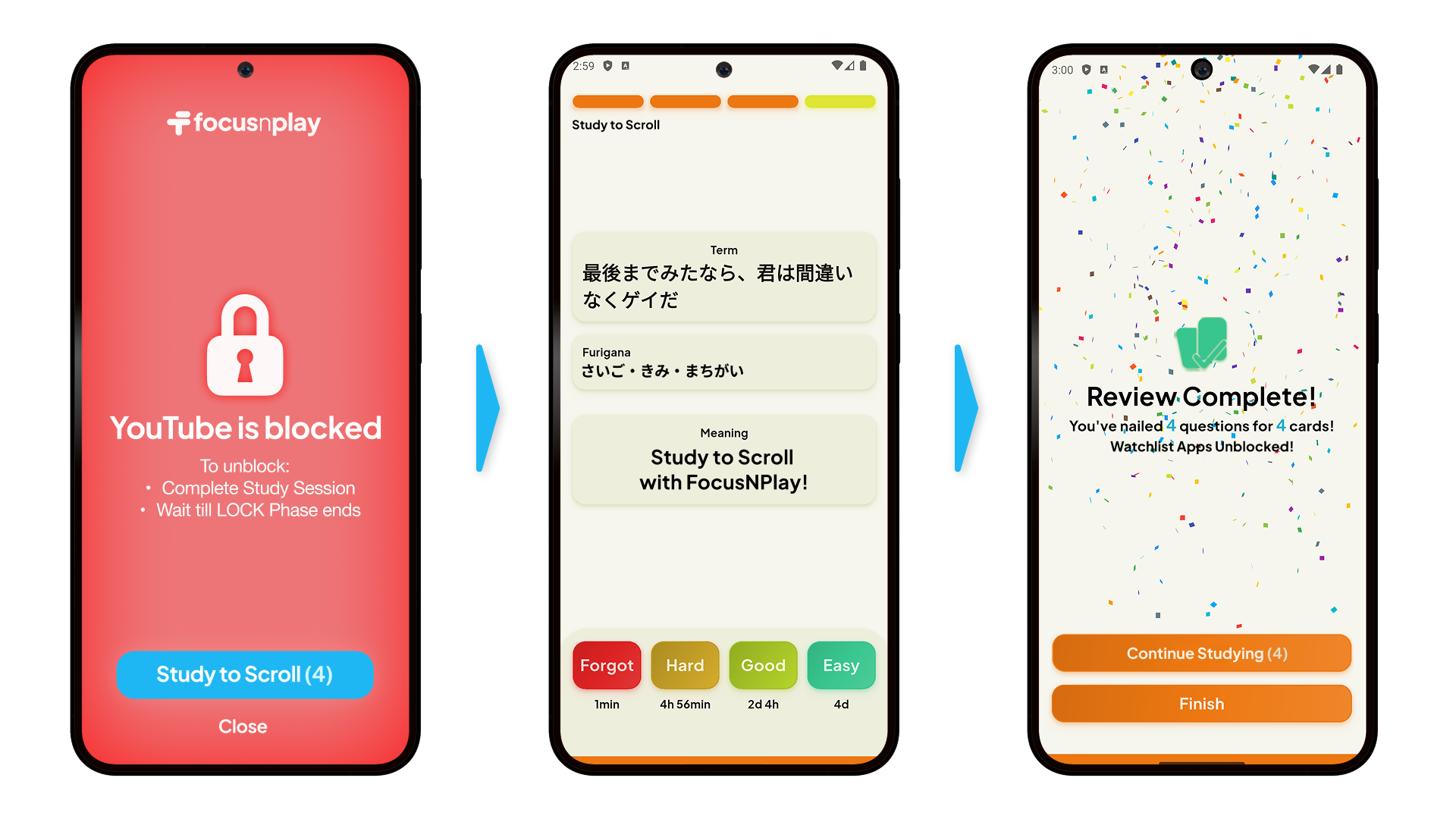
FocusNPlay's Study to Scroll is built around a gamified approach to block distractions while building genuine learning habits. Here's the key difference: instead of just blocking your apps and forcing you to wait, it offers you a choice.
When you hit your time limit on Instagram, TikTok, or any distracting app:
- Option 1: Wait out the cooldown period (usually 30-60 minutes)
- Option 2: Complete a quick 5-10 question study session to instantly unlock your apps
The psychology behind this is realistic. You're not being punished; you're earning your entertainment. Each time you choose to complete the study session, you're:
- Learning something new (micro-learning accumulates fast)
- Creating positive associations with studying (it gives you what you want)
- Building a sustainable habit (gamification makes it enjoyable)
- Reducing overall screen time (you'll naturally use apps less when there's a "study cost")
Real-world practice: Let's say you typically scroll for 2 hours daily. With Study to Scroll, you complete 5-10 micro-study sessions per day, each taking just 2-3 minutes. That's 50-100 new facts or concepts learned daily, almost effortlessly, just by maintaining the screen time you were already going to use anyway.
Over a semester (roughly 120 days) later, 6,000-12,000 pieces of information are reviewed through active recall. And here's the best part: because you're using the app block feature combined with gamification, you're actually reducing your total screen time while learning more.
Setting up
- Download FocusNPlay.
Create question banks for your current courses. Spend 10 minutes creating 20-30 questions from your lecture notes or textbook. These become your "unlock currency" for the week.
Set realistic app limits. Don't go from 3 hours to 30 minutes overnight. Start with your current usage, then gradually reduce by 15-20% each week.
Choose the right subjects. Study to Scroll works best for memorization-heavy subjects (anatomy, vocabulary, historical dates, formulas) and quick concept reviews.
Track your progress. The built-in analytics show you how much you're learning and how your screen time is decreasing. These small wins fuel motivation.
Don't risk reviewing everything in one sitting
We severely underestimate just how much knowledge we can accumulate every day.
Ask any medical student and they will tell you that they study 100-300 new cards per day on tools like Anki, powered by the software's built-in Spaced Repetition system.
If each card takes 20 seconds to recall, you're looking at 2 hours just to finish off the new cards. A few days later, and you would have to spend an equal amount of time reviewing the old ones. Good luck keeping that consistency!
It's no wonder that these students burn out. Many students try doing all cards in one go, everyday. Sure, the progress may seem to catch up fast, but so will your mental fatigue! It's like eating an entire day's worth of food in one sitting. Would your stomach be able to digest all those meals?
Trying to stick large volumes of flashcards into your head is challenging, but it's definitely possible, as long as it's strategic.
To read more on Spaced Repetition, skip to another section below.
Break them down, spread them across the day
The most frequent thing we do during the day is looking at our phones. The average person checks their phone between 80 to 144 times a day, which translates to staring at their screen for 5 to 12 minutes every time.
And now with the Study to Scroll method, you can transform them into opportunities of learning. Every time you scrolled enough on social media, complete 10-20 reviews. This will dice down the giant flashcard turkey into delicious, bite-sized snacks.
The Pomodoro Technique: Time-tested focus method

The Pomodoro Technique was invented by Francesco Cirillo, a university student who "struggled to focus on his studies and complete assignments". Decades later, it remains one of the most effective time management methods for students worldwide.
Why it works
The Pomodoro Technique is famously known for boosting productivity and focus. It breaks your work into manageable chunks, preventing mental fatigue while maintaining high-quality focus. The classic example is 25/5 split - 25 minutes of deep focus followed by 5 minutes of resting, on repeat.
The science can back this up: our brains can maintain peak focus for approximately 25-30 minutes before attention naturally wanes. Performing mentally-intensive tasks with this natural rhythm rather than against it, you accomplish more while feeling less exhausted.
The classic Pomodoro method
Choose a specific task you want to work on. Be specific: "Read Chapter 5 and take notes on cellular respiration" not just "study biology."
Set a timer for 25 minutes. During this time, focus exclusively on your chosen task. No phone checks, no email, no social media.
When the timer rings, take a 5-minute break. Stand up, stretch, get water, look away from your screen. This isn't optional; breaks are crucial.
Repeat the cycle. After completing four Pomodoros (about 2 hours of work), take a longer 15-30 minute break.
Track your Pomodoros. Mark down how many you complete per day. This creates accountability and shows progress.
Best Pomodoro splits for different tasks
For reading-heavy subjects: Use the 25/5 split. During breaks, jot down the main points you just read to reinforce memory.
For problem-solving (math, physics, coding): Try 50/10 intervals. Complex problems need longer sustained attention. Breaking them down can be counterproductive.
For writing essays or reports: Start with 25/5 to outline and draft, then extend to 45/10 when you're in flow state and the words are coming easily.
Common mistakes to avoid:
People skip breaks thinking it'll be more productive, but that usually backfires. The reason why breaks are there is so that your brain can have time to consolidate what you just learned.
Checking your phone during the focus time. Even a quick glance breaks your concentration and costs you 3-5 minutes of refocusing time.
Being too rigid with the timing. If you're deep in flow at minute 25 and stopping would cost your train of thought, then try to wrap up your current sub-task within reason, then take a break.
Phase Timer: An app block timer designed for Pomodoro
With FocusNPlay's Phase Timer, it will time each focus / break period for you, notifying when to start / stop doing your task. You can also customize each split durations to your likings, as well as turning on app blocking for during focus phases.
Spaced Repetition: Fight against your innate forgetfulness

Based on decades of learning science research, spaced practice / distributed practice – learning that occurs over multiple sessions at different points in time – is one of the two most effective methods known to date.
German psychologist Hermann Ebbinghaus discovered that we forget information rapidly after first learning it, but reviewing material just before we forget it dramatically strengthens memory. This is the forgetting curve in action, and spaced repetition being the solution.
How Spaced Repetition works
Instead of cramming all your studying into one marathon session the night before an exam (which creates memories that disappear within 48 hours), you review material at strategically increasing intervals:
- Day 1: Learn new material
- Day 2: First review (1 day later)
- Day 5: Second review (3 days later)
- Day 12: Third review (1 week later)
- Day 26: Fourth review (2 weeks later)
- Day 54: Fifth review (4 weeks later)
As you successfully recall information just as you're about to forget it, the memory becomes more durable and the interval before the next review increases.
The king of memorization
Research shows spacing increases retention by up to 80% compared to massed practice. Think about that: you could study half as much time and remember nearly twice as much, simply by spacing out your reviews.
Passive review of study material by simply re-reading lecture notes or highlighting textbooks creates a false sense of familiarity rather than true understanding. Spaced repetition forces your brain to perform actual retrieval, strengthening memory.
Implementing Spaced Repetition
Manual method (paper flashcards)
Create flashcards as you learn new material. On the front, write a question or prompt. On the back, write the answer. Organize cards into boxes labeled "Daily," "Every 3 Days," "Weekly," "Bi-Weekly," and "Monthly."
When you successfully recall a card, move it to the next box with a longer interval. When you fail to recall a card, move it back to "Daily." This simple system is called the Leitner System.
Digital tools (apps)
Apps like FocusNPlay, Anki, and Quizlet automate the spacing for you using sophisticated algorithms. They track which cards you struggle with and show those more frequently, while cards you know well appear less often.
Study to Scroll
If you're using the Study to Scroll in FocusNPlay, your mini study sessions already incorporate spaced repetition. The app automatically spaces out which questions appear based on your performance, combining the power of spaced repetition with the motivation of earning your screen time.
Subjects that benefit most
Languages (vocabulary, grammar rules), medical terms (anatomy, pharmacology), law (case names, statutes), sciences (formulas, definitions, processes), and history (dates, events, key figures).
Making it sustainable
Start small with just 10-15 new cards per day. This seems tiny, but after one month you'll have 300-450 cards in rotation. After one semester, you'll master over 1,800 concepts.
Review every single day, even weekends. Missing days disrupts the spacing intervals and reduces effectiveness. Think of it like brushing your teeth – just 10-15 minutes daily, non-negotiable. With FocusNPlay, you can track daily goals and streak to maintain participations.
Active Recall: Stop reading, start testing

If you could only use one study technique, make it this one. Retrieval practice / practice testing – attempting to recall information from memory rather than simply re-reading information – is one of the two most effective methods known.
The passive learning trap
Most students study passively: reading textbooks, reviewing lecture slides, highlighting notes, watching videos. These methods feel productive because the information seems familiar when you see it again. But familiarity isn't the same as actually knowing something.
Pharmacy students rely heavily on traditional learning methods like passive review of learned material and rote memorization that eventually leads to rapid forgetting and poor long-term retention.
Why Active Recall works
Active recall flips passive learning upside down. Instead of putting information into your brain (reading), you force your brain to pull information out (testing yourself). This retrieval process:
- Strengthens neural pathways for that specific memory
- Reveals exactly what you don't know (closing knowledge gaps)
- Creates deeper, more flexible understanding
- Improves your ability to apply knowledge in different contexts
Research consistently shows that students who practice active recall retain 50-80% more information than those who use passive study methods like re-reading or highlighting.
Practical Active Recall techniques
The blank page method: After reading a chapter or attending a lecture, close your materials. Take out a blank sheet of paper and write everything you can remember about the topic. Don't peek. When you get stuck, leave gaps and continue. Only after you've exhausted your memory should you open your notes to fill in what you missed.
Flashcard self-testing: Create questions while you study, then quiz yourself later. The key is to actually try to retrieve the answer before flipping the card, even if you're not confident. The struggle to remember is what creates strong memories.
Practice problems without solutions: For subjects like math, physics, or chemistry, attempt practice problems without looking at your notes or solution manuals. Work through each problem completely, showing all steps. Only check solutions after you've attempted everything.
Teach-back method: Explain concepts out loud as if teaching a friend or younger sibling. If you can't explain it simply, you don't understand it well enough. This combines active recall with the Feynman Technique (more on this next).
Past exam questions: Many professors provide old exams or sample questions. These are gold. Attempt them under timed conditions without any materials, then review your performance.
Combining Active Recall with Study to Scroll
The mini study sessions in Study to Scroll are pure active recall practice. Each time you complete questions to unlock your apps, you're strengthening memories through retrieval. The gamification makes it feel effortless, but the learning science is working in the background.
The difficulty sweet spot
Active recall should feel challenging. If you're getting everything right immediately, you're not training your memory enough. Use harder questions or longer intervals. If you're getting everything wrong, go back and re-review before testing again.
Research demonstrates that traditional easy forms of passive learning show better temporary performance effects, but more difficult tasks, such as learning with active recall, result in improved performance in the long-term. The struggle is the point.
The Feynman Technique: Explain it like they're five

Named after Nobel Prize-winning physicist Richard Feynman, this technique is deceptively simple: if you can't explain something in simple terms, you don't really understand it.
Most study techniques focus on memorizing information. The Feynman Technique flips that script: students learn by explaining, transforming complex ideas into clear, teachable language that reveals real understanding.
The four-step process
Step 1: Choose a concept
Pick one specific topic you need to understand. Write it at the top of a blank page. It could be "photosynthesis," "supply and demand," "Newton's Second Law," or "the causes of World War I."
Step 2: Teach it simply
Explain the topic to someone who doesn't know it well, like a child. Write out your explanation using the simplest language possible. Avoid jargon, technical terms, and complex vocabulary. If you must use a technical term, immediately define it in simple words.
Step 3: Identify gaps
Recognize where your explanation falls short or gets confusing. This is a crucial moment in your learning process. When you get stuck, can't simplify something, or realize you're using complex language to hide that you don't really understand, you've found a gap.
Step 4: Review and simplify
Go back to your source materials and study specifically the areas where you struggled. Then rewrite your explanation, making it even simpler. Repeat until you can explain the entire concept clearly without any notes.
Why this works so well
Feynman believed that learning a new skill or concept should be an active process of "trial and error, discovery, free inquiry." He held that if you couldn't explain something clearly and simply it was because you didn't understand it well enough.
The act of translating complex ideas into simple language forces you to truly process and understand the material, not by just memorizing surface-level facts. It reveals the difference between recognition (seeing something and thinking "oh yeah, I know that") and actual comprehension.
Making it practical
Study group application: Form a group, take turns teaching each other different concepts. The person listening should actively ask "why?" and "how?" questions like a curious child would.
Record yourself: Use your phone to record yourself explaining concepts out loud. Play it back. If it sounds confusing to you, it's confusing. Revise and record again.
Write blog posts or study guides: Explain course concepts as if creating a study guide for students taking the class next semester. The act of teaching through writing cements your understanding.
Combine with active recall: After using the Feynman Technique to understand a concept, create active recall questions to test your retention later.
Interleaving: Mix it up for deeper learning

Most students study using "blocked practice" – they focus exclusively on one topic or one type of problem until they've "mastered" it, then move to the next topic. Interleaving as a study method means learning more than one subject or skill and switching between them.
Counter-intuitively, this mixing up of topics actually leads to better long-term retention and problem-solving ability.
Why interleaving works
When you practice the same type of problem repeatedly, your brain goes into autopilot. You're not really thinking about the underlying principles; you're just pattern-matching and executing a formula you used ten times over.
Interleaving forces your brain to actively discriminate between different concepts and problem types. One study showed that interleaving learning boosted the ability of physics students to present correct solutions by a median of 50 percent.
When you alternate between different topics or types of problems, interleaving is thought to promote the ability to discern key differences between concepts and enhance the ability to apply and transfer knowledge to new and varied situations.
How to apply interleaving
For problem-based subjects (math, physics, chemistry)
Instead of first doing 20 algebra problems, then 20 geometry problems, do them alternately: 2-3 algebra, then 2-3 geometry, then 2-3 trigonometry, then back to algebra.
The key is mixing problems that require different approaches, forcing you to identify what type of problem you're solving before you can solve it.
For conceptual subjects (biology, history, psychology)
During a 2-hour study session, spend 30 minutes on cellular biology, then 30 minutes on genetics, then 30 minutes on evolution, then 30 minutes back to cellular biology. Alternate the order in subsequent sessions.
For multiple courses
Don't study one subject per day. Instead, divide your study time between 2-4 different courses in a single session. For example: 45 minutes on economics, 45 minutes on statistics, 45 minutes on marketing, then another round.
Important considerations
Interleaving works best after students have gained some level of competency. Trying to interleave complex material too soon — before learners have mastered the basics — can create frustration and hinder progress.
First, learn the fundamentals of each topic individually. Once you understand the basics, begin interleaving. The technique works by strengthening discrimination between concepts you already somewhat understand, not by teaching completely new material.
Students actually performed worse on the end of week quizzes that utilized interleaved practice versus blocked practice. But when we look at the final test given a month later, in every instance, students performed better on the questions that were interleaved.
This is important: interleaving feels harder and your initial performance can be poor. But trust the process - the difficulty is what creates the long-term benefits.
Practical schedule
Week 1-2: Block practice (learn topics separately)
Week 3-4: Begin interleaving related topics within the same subject
Week 5+: Interleave across different subjects
Monitor your progress. If you're completely lost, you've interleaved too soon or the topics are related too loosely. Go back to blocked practice to strengthen foundations, then try again.
Visual Learning: Drawings and concept maps
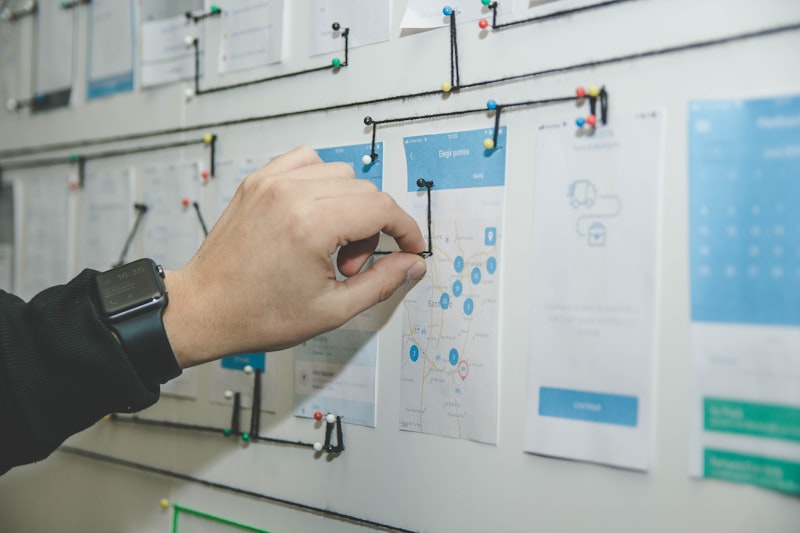
While less commonly discussed than active recall or spaced repetition, the use of drawings (both representational drawings and concept maps) has experimental support as an effective study strategy.
Why drawings work
Drawing an image that represents a scientific process requires students to select information, organize the information, form a mental representation, and then translate this newly formed model to a physical representation.
This multi-step process engages your brain far more deeply than simply reading text. You can't draw something you don't understand.
Creating effective study drawings
Process diagrams

For biological processes (cell division, protein synthesis, photosynthesis), historical events (timeline of a war), or chemical reactions, draw step-by-step diagrams showing how one thing leads to another.
Concept maps
Start with a central concept in the middle of your page. Branch out to related ideas, connecting them with lines and arrows. Label the connections to show relationships ("causes," "leads to," "is part of," "contrasts with").
Annotated illustrations
Draw or trace anatomical structures, machines, geological formations, or cell structures, then label every component and write brief notes explaining what each part does.
Before-and-after comparisons
Draw two versions showing a system before and after a change, highlighting what's different and why.
Combining With Other Techniques
Visual + Active Recall
After studying a diagram, put it away and redraw it from memory. Check your drawing against the original, noting what you forgot or got wrong.
Visual + Feynman
Create a drawing while explaining the concept out loud in simple terms. Your drawing should match your explanation.
Visual + Spaced Repetition
Redraw the same diagram from memory at spaced intervals (1 day, 3 days, 1 week).
Don't worry about artistic skill. These are study tools, not art projects. Stick figures, boxes, and simple shapes work perfectly fine. The cognitive engagement matters, not the aesthetic quality.
You passed! Now what?

Congratulations – you've made it through your exams. But your relationship with these study techniques shouldn't end even when the semester does.
Building long-term learning habits
The techniques in this guide aren't just for passing tests; they're frameworks for learning anything throughout your life. Whether you're learning a new language, picking up a musical instrument, or mastering a professional skill years after graduation, active recall, spaced repetition, and interleaving will serve you well.
Reflecting on what worked
Take 15 minutes after each exam period to journal about your study approach:
- Which techniques felt most effective for different types of material?
- Which subjects responded best to which methods?
- Where did you struggle, and what would you change next time?
- How much screen time did you save using Study to Scroll, and how many micro-learning sessions did you complete?
This reflection helps you continuously refine your approach, making each semester more effective than the last.
Planning for next semester
Don't wait until you're drowning in coursework to implement these techniques. During your break:
- Set up your Study to Scroll question banks for next semester's courses
- Create a master calendar marking out spaced repetition review sessions
- Organize your study space
- Download necessary apps (Anki, forest timers, Pomodoro apps)
- Create a realistic weekly schedule that includes daily study sessions
The compound effect of small improvements

Here's what really matters about these techniques: the compound effect.
If you use Study to Scroll to block distractions and complete just 5 mini study sessions daily, that's 35 sessions weekly, 150 per month, 1,800 per year. Each session reviews 5-10 concepts. Now if we add them up – that's 9,000-18,000 retrievals annually, turning your phone addiction into a powerful learning tool.
If you use spaced repetition to add just 10 new flashcards daily, after one year you'll have reviewed over 18,000 cards through increasingly spaced intervals, creating permanent knowledge that would have taken vastly more study time through traditional methods.
If you replace one hour of passive reading with one hour of active recall each day, your retention could improve by 50-80%, effectively giving you photographic memory compared to your former study habits.
Share your success
As these techniques are working for you, share them with classmates. Study groups become exponentially more effective when everyone knows how to study properly. Teaching others these methods also reinforces your own understanding and commitment.
Final thoughts
University is demanding. The volume of material, the complexity of concepts, and the high stakes of finals create enormous pressure. And if it's already as overwhelming as it seems, don't work any harder – you need to work smarter.
The techniques in this guide are backed by decades of cognitive science research. They've been proven effective across millions of students, in every subject, at every level. They work because they align with how your brain actually learns and remembers.
Start with one or two techniques. Master them. Then add more. Be patient with yourself. These are skills that improve with practice.
Remember: the phone in your pocket doesn't have to be your enemy. With Study to Scroll, you can turn every moment of procrastination into an opportunity for growth, transforming the app block from frustration into motivation.
You've got this. Go prove it.
Further Reading
For more information on effective study techniques and academic success: